Contact Lens Picking and Packing: Order Accuracy at 1,500+ Designs
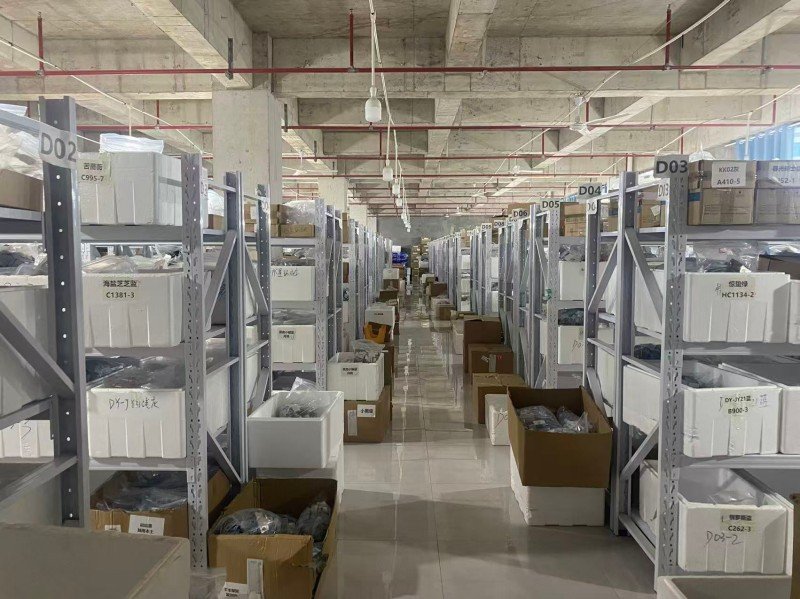
Quick answer: Contact lens picking does not fail because of volume. It fails because of similarity — two shades that look alike, one design in six powers, four base curves, and a picker reading a paper list. Accuracy comes from three controls: slot designs by how often they are picked rather than by colour family, scan the design code at the pick face instead of reading it, and reconcile the assembled order line by line before the carton is sealed.
Key takeaways
- Similarity is the risk, not volume. Near-identical designs and parameter multiplication cause most substitutions, not order size.
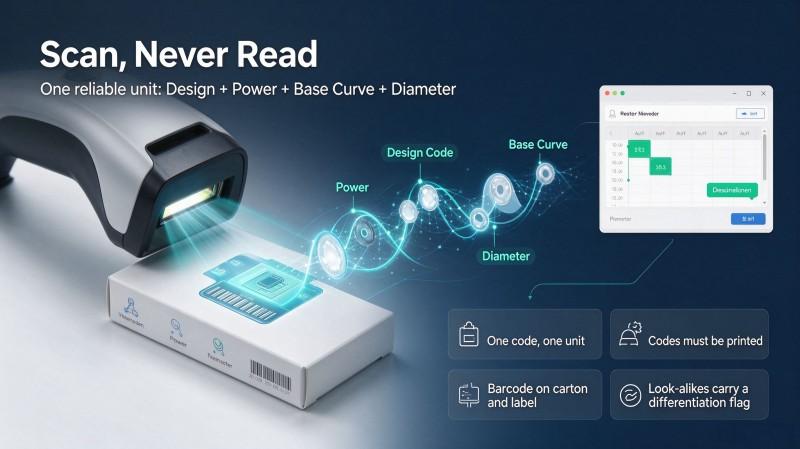
- Scan, never read. A design code that carries power, base curve and diameter is the only unit of truth in contact lens picking.
- Three gates, not one. Pick, pack and documentation checks each catch a different error class, and each costs seconds.
- Freeze the order at allocation. Post-allocation changes are the main reason a 7–10 day dispatch promise slips.
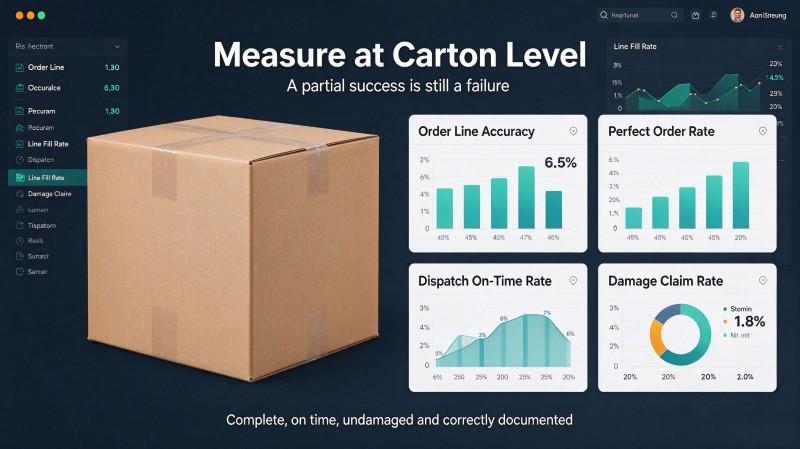
- Measure at carton level. An order that ships 11 of 12 lines is not 92% successful; it is a failure with a good average.
KSSEYE (Beautylens Technology) ships from a catalogue of 1,500+ ready-ship designs across daily, monthly and yearly lenses, launches 100+ new designs a year, and works to a 7–10 day delivery window from China. That combination — very wide catalogue, short promise — is precisely the condition in which contact lens picking discipline decides whether a distributor reorders.
Why does a 1,500-design catalogue break paper picking?
Paper picking breaks under four properties that are specific to contact lenses: visual near-duplicates, parameter multiplication, small light units, and expiry as a constraint. Contact lens picking carries all four at once.
- Near-identical variants. Designs are separated by tone, ring pattern and diameter. Two cartons of the same family look the same under warehouse lighting and different on a customer's eye.
- Parameter multiplication. One design may exist in many powers, several base curves and two diameters. The design name alone is not the SKU.
- Small, light units. Low weight per carton encourages hand-carrying, split cartons and improvised stacking — where lot links break.
- Expiry as a constraint. Contact lens picking is not only "right design, right power" but "right batch", because a later-expiring carton cannot ship ahead of an earlier one.
A paper pick list handles the first problem badly and the fourth not at all.
How should contact lens stock be slotted?
Slot by pick velocity, then sub-sort by design family. ABC slotting is standard; the second sort is what makes contact lens picking fast without raising near-miss errors.
| Class | Share of pick lines | Location | Replenishment |
|---|---|---|---|
| A | The designs that appear on most orders | Golden zone, waist height, nearest the pack bench | Continuous, min/max triggered |
| B | Regular but not dominant | Mid-aisle, upper and lower shelves | Daily review |
| C | The long tail of the catalogue | Reserve racking, picked to order | Weekly review |
Within each slot, keep the same colour family together so a picker's eye does not re-orient between picks. That is a picking aid, not a merchandising decision: the moment slotting follows how a catalogue page looks, travel time rises and near-miss picks rise with it. Re-slot quarterly on pick-frequency data — a fashion-driven catalogue moves, and an eighteen-month-old slotting plan is a map of last season's bestsellers.
What makes a design code reliable?
Contact lens picking is only as reliable as its design code, and a design code is reliable when one code maps to exactly one sellable unit — design plus power plus base curve plus diameter. Four rules make that true.
- One code, one sellable unit. If the code omits any of the four parameters, the warehouse and the customer are using different definitions of the same product.
- The code is printed, not interpreted. No abbreviations invented at the bench, no "the blue one".
- The code is barcoded on the carton and on the pick label. Scanning is the control; reading is the fallback.
- Look-alike designs carry a differentiation flag in the system — a second check for the small set of genuinely confusable designs.
The fourth rule is the one suppliers skip and distributors notice first, because a look-alike substitution produces a complaint that sounds like a quality problem and is actually a contact lens picking problem.
Which verification gates stop wrong-shade shipments?
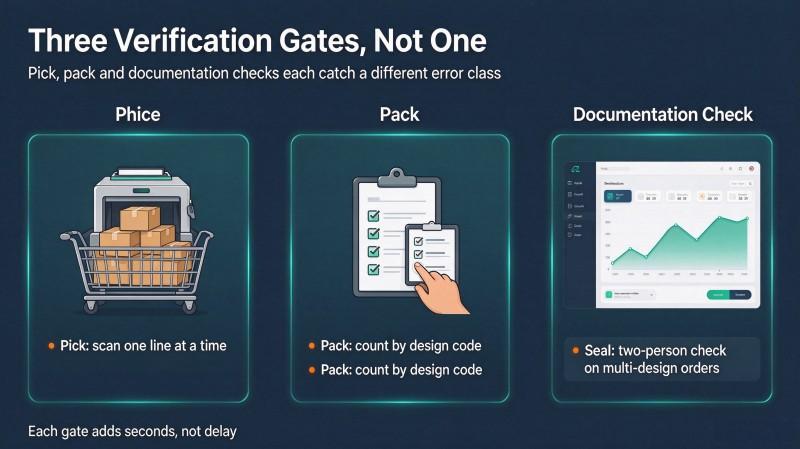
Contact lens picking needs three gates, in sequence: pick, pack and documentation. Each targets a distinct failure mode, and none is a substitute for another.
| Stage | Action | Control | Failure it prevents |
|---|---|---|---|
| Order intake | Confirm design, power, quantity against the offer | Re-check against the catalogue record, not the email thread | Order taken from a screenshot or chat message |
| Allocation | Assign stock by earliest expiry within the confirmed design | System-enforced FEFO | Later batch shipped; earlier batch ages into write-off |
| Pick | Scan the design code at the pick face | Scan-and-confirm, one line at a time | Near-identical shade substituted |
| Pack | Reconcile assembled units against the picking list | Count per design code, not total units | Short line hidden by a correct total |
| Seal | Compare carton marks and packing list before closing | Two-person check on multi-design orders | Wrong carton closed and labelled |
| Documentation | Match packing list, invoice and carton marks on SKU, quantity and lot | Single document owner | Customs query or customer dispute |
| Handover | Photograph the sealed carton and the load | Timestamped photo set | Damage claim with no evidence |
The pattern is deliberate: in contact lens picking every gate is cheap and catches a different error class. Suppliers who rely on a final inspection discover problems after the carton has left the building, when the only remedy is a credit note and a delay.
How do you assemble mixed-SKU orders accurately?
In contact lens picking, give each order its own bench position and its own carton from the first pick. Mixed orders fail in three predictable ways.
- Bench crowding. Two orders on one bench, one carton too many. Fix: one order per position, physically separated.
- Split cartons without labels. Someone needs 30 units from a 100-unit carton and the remaining 70 go back unlabelled. Fix: split only at a labelled split station, transferring lot and expiry to both parts.
- Inner-pack damage during consolidation. Units pressed into a smaller outer carton. Fix: pack to the carton, not to the freight quote — a creased blister is a compromised sterile barrier, not a cosmetic defect.
For distributors assembling a first range, the 12-SKU launch plan is a useful counterweight: fewer designs, deeper quantities, fewer picking permutations. Width is a marketing decision; depth is a warehouse decision.
What consumes the 7–10 day dispatch window?
The window is consumed by handoffs, not by contact lens picking speed. Each stage needs an owner and a cut-off, and delays cluster in two places: post-allocation changes and documentation gaps.
| Stage | What happens | Where the days go |
|---|---|---|
| Order confirmation | Design codes, quantities, powers locked; proforma issued | Ambiguous codes, quantities changed after allocation |
| Stock allocation | FEFO assignment across confirmed lines | A design that is in stock but committed to another order |
| Picking and QC | Pick, verify, visual check on foil and carton | Multi-design orders with several look-alike lines |
| Packing and marking | Carton marks, packing list, seal | Late changes to address or shipping marks |
| Documentation | Invoice, packing list, certificate set, origin documents | Missing or mismatched lot references |
| Booking and handover | Carrier booking, load, photograph | Peak-season capacity, not warehouse speed |
Two rules protect the promise better than any expediting: freeze the order at allocation (changes after that point move to the next dispatch rather than into a picker's hands mid-order), and close documentation before packing, so a carton is never sealed against incomplete paperwork.
How should returns and short-ships be handled?
Returns belong in the contact lens picking flow, not in customer service, because that is where the evidence is. Five steps, in order.
- Receive into a separate returns area — never back onto a pick face.
- Match the return to the original carton and lot, using the dispatch photo set.
- Classify: contact lens picking error, transit damage, supplier defect, customer over-order.
- Decide disposition — restock only if carton, foil and lot are verifiably intact and expiry supports resale; otherwise quarantine and write off.
- Feed the cause back into slotting, packing or documentation. A repeated picking error is a slotting problem; a repeated damage claim is a packing problem.
The most common mistake is restocking a returned carton because it "looks fine". In a regulated category, "looks fine" is not a release decision.
Which metrics predict complaints?
Measure contact lens picking at carton and line level, not order level. Five numbers do most of the work.
| Metric | How to calculate | What it tells you |
|---|---|---|
| Order line accuracy | Error-free lines ÷ lines shipped | The best single predictor of reorders |
| Perfect order rate | Orders complete, on time, undamaged, correctly documented ÷ total orders | What the customer actually experiences |
| Line fill rate | Lines shipped complete ÷ lines ordered | Whether catalogue width is real or theoretical |
| Dispatch on-time rate | Orders handed to carrier within the window ÷ orders | Whether the 7–10 day promise holds under load |
| Damage claim rate | Claimed cartons ÷ cartons shipped | Packing and loading quality, independent of the carrier |
How do you staff peak season without losing accuracy?
Contact lens picking peaks cluster around festivals, holidays and seasonal colour shifts, and they are usually handled badly in one of two ways: overtime until error rates rise, or temporary staff on the pick face with no product training.
A third contact lens picking model works better:
- Cross-train packers on picking and pickers on documentation, so the bottleneck can move.
- Pre-build fast-mover kits before known peaks — the pick becomes a single scan of a prepared carton.
- Restrict temporary staff to packing and carton marking, with a scanned verification by a trained operator before sealing.
- Freeze new-design introductions during the peak window unless the launch is the reason for the peak.
What should a buyer ask before a first order?
Five questions separate a supplier with a contact lens picking process from a supplier with a stock list.
- How is the design code structured, and does it include power, base curve and diameter?
- Is stock allocated by earliest expiry, and can remaining shelf life appear on the packing list?
- How many verification points sit between the pick face and the sealed carton?
- What is the documented dispatch window, and what happens to an order that misses it?
- Can you send the carton-level photo set before a shipment leaves?
A supplier who answers all five without a follow-up call has a process. Our catalogue is organised by replacement cycle and design family, and each design page carries the parameters that make a pick unambiguous — for example the Macabaka Purple four-tone 14.2 mm and the Ashy Bubble Grey five-tone. Once stock lands, the receiving and rotation rules in our distributor storage guide take over.
Frequently asked questions
How do you keep order accuracy high with 1,500+ contact lens designs? Contact lens picking stays accurate by scanning rather than reading. Each pick scans a design code that contains power, base curve and diameter, and the assembled order is verified line by line before sealing. Slotting by pick frequency reduces travel and near-miss picks at the same time.
What is the difference between order line accuracy and perfect order rate? Line accuracy counts individual lines shipped correctly. Perfect order rate counts orders that were complete, on time, undamaged and correctly documented. One short line fails the order but barely moves the line average, which is why both are tracked.
Should contact lens picking use FIFO or FEFO? FEFO. Arrival date is not a reliable proxy for remaining shelf life, and shipping a later batch ahead of an earlier one turns good stock into write-off.
How should split cartons be handled? Split only at a labelled station, and transfer the original lot and expiry to both the picked part and the remainder. Never leave an unlabelled partial carton on a pick face.
What causes most contact lens picking errors? Look-alike designs combined with ambiguous design codes. Colour families with subtle tone differences, and codes that omit power or base curve, account for most substitutions.
How is a 7–10 day delivery window protected? By freezing the order at allocation, completing documentation before packing, and giving each stage a named owner and cut-off. Most delays come from post-allocation changes and documentation gaps, not picking speed.
How many designs should a first distributor order carry? Fewer than the catalogue allows. Contact lens picking gets harder with width, not easier. A 12-SKU range with depth ships with fewer picking permutations and fewer split cartons than a 60-design range with thin quantities, and it is easier to rotate within shelf life.
Can a supplier ship a design that is in stock but committed to another order? No — allocation, not inventory, is the promise. Which is why order confirmation should state the allocation date, and why post-allocation changes belong to the next dispatch.
Sources
- ISO, ISO 13485 — Medical devices, quality management systems
- WHO, Guidelines: distribution — good storage and distribution practices for medical products
- WHO, TRS 1044 Annex 8 — remaining shelf life of medical products upon delivery
- FDA, Contact Lens Risks
- CDC, Preventing Eye Infections When Wearing Contacts
About the author: Written by the KSSEYE supply chain team at Beautylens Technology Co., Ltd., which supplies 1,500+ ready-ship contact lens designs with ISO 13485 quality control, CE-certified production and batch traceability, from an FDA-registered facility (FEI 3015587162).
For catalogue, dispatch and documentation questions, contact sales@eyesbeautylens.com or WhatsApp +86 176 0731 1512. If contact lens picking is where your supplier's promise breaks, the first thing to audit is not speed — it is whether every carton on the pick face carries a code that identifies exactly one sellable unit.