Colored Contact Lens Assortment: A 12-SKU Launch Plan
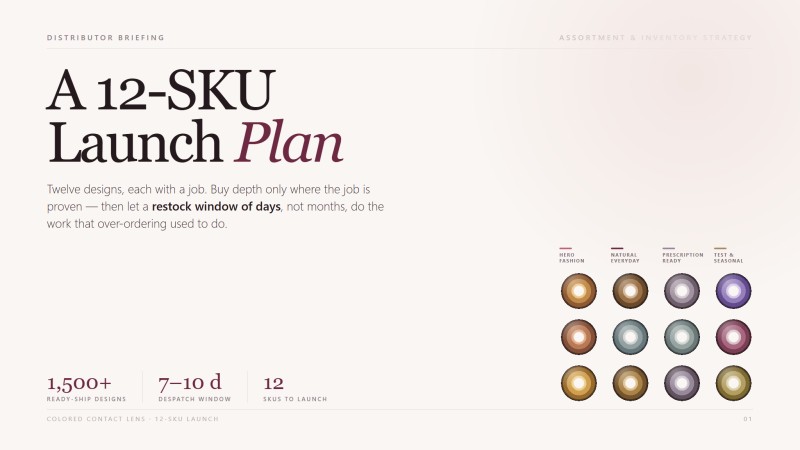
Quick answer: Launch with twelve SKUs, not a hundred and fifty. Give each SKU a job — hero fashion, natural everyday, prescription-ready, or test — and buy depth only where the job is proven. Then let a restock window of days, not months, do the work that over-ordering used to do. A distributor with 12 well-chosen SKUs and a fast replenishment cycle will out-sell a distributor with 80 SKUs and a warehouse full of slow movers.
This is written for the people who hold the inventory: importers, regional distributors, optical chain buyers and the buyer who has to explain the closing stock report. Our catalogue carries 1,500+ ready-ship designs, and the most common mistake we see is not a bad design choice — it is a bad first order shape.
The 1,500-design problem
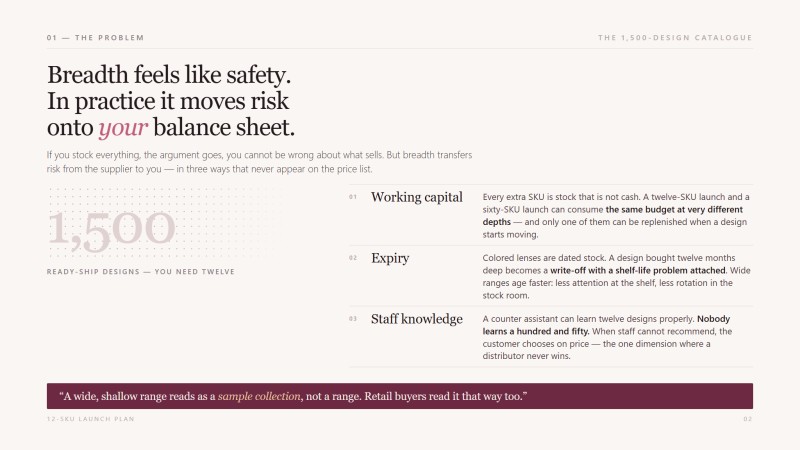
Breadth feels like safety. If you stock everything, the argument goes, you cannot be wrong about what sells. In practice breadth transfers risk from the supplier to you, and it does so in three ways that never appear on the price list.
Working capital. Every extra SKU is stock that is not cash. A twelve-SKU launch and a sixty-SKU launch can consume the same budget at very different depths, and only one of them can be replenished when a design starts moving.
Expiry. Colored lenses are dated stock. A design that sells four pairs a week is fine; the same design bought twelve months deep becomes a write-off with a shelf-life problem attached. Wide ranges age faster than narrow ones because each SKU gets less attention at the shelf and less rotation in the stock room.
Staff knowledge. A counter assistant can learn twelve designs properly — which tones suit which iris, which diameter enlarges, which pattern reads natural in daylight. Nobody learns a hundred and fifty. When staff cannot recommend, the customer chooses on price, and price is the one dimension where a distributor never wins.
There is a fourth cost that is harder to quantify: a wide, shallow range looks like a sample collection, not a range. Retail buyers read it that way too.
Four roles, three SKUs each
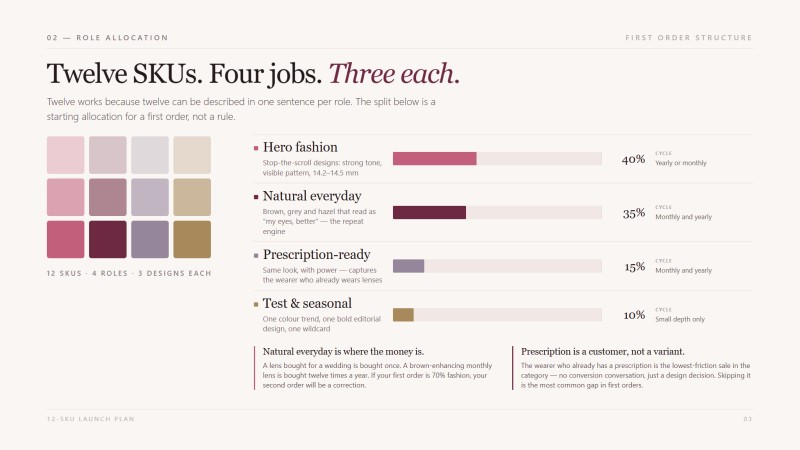
Twelve SKUs work because twelve can be described in one sentence per role. The distribution below is a starting allocation for a first order, not a rule.
| Role | SKUs | Share of opening buy | What it must do | Replacement cycle |
|---|---|---|---|---|
| Hero fashion | 3 | ~40% | The designs that make someone stop scrolling: strong tone, visible pattern, 14.2–14.5 mm | Yearly or monthly |
| Natural everyday | 3 | ~35% | Brown, grey and hazel tones that read as "my eyes, better" — the repeat-purchase engine | Monthly and yearly |
| Prescription-ready | 3 | ~15% | Same look, with power; captures the wearer who already wears lenses | Monthly and yearly |
| Test and seasonal | 3 | ~10% | One colour trend, one bold editorial design, one wildcard | Small depth only |
Two structural points behind the table:
The natural-everyday role is where the money is, even though the hero designs get the attention. A cosmetic lens bought for a wedding is bought once; a brown-enhancing monthly lens is bought twelve times a year. If your first order is 70% fashion, your second order will be a correction.
Prescription-ready is a different customer, not a variant. The wearer who already has a prescription is the lowest-friction sale in the category — no conversion conversation, just a design decision. Skipping this role to save budget is the single most common gap we see in first orders.
Designs that fit each role, from the current range:
- Hero fashion: Southern French Holidays Blue four-tone 14.5 mm and Macabaka Purple four-tone 14.2 mm — four tones give the iris depth that a flat two-tone print cannot.
- Natural everyday: Pear Brown two-tone 14.5 mm and Perfect Marriage Brown & Grey three-tone 14.5 mm.
- Prescription-ready: Ashy Bubble Grey five-tone 14.2 mm.
- Test and seasonal: LA Girl three-tone 14.2 mm as the trend slot.
The rule that replaces over-ordering
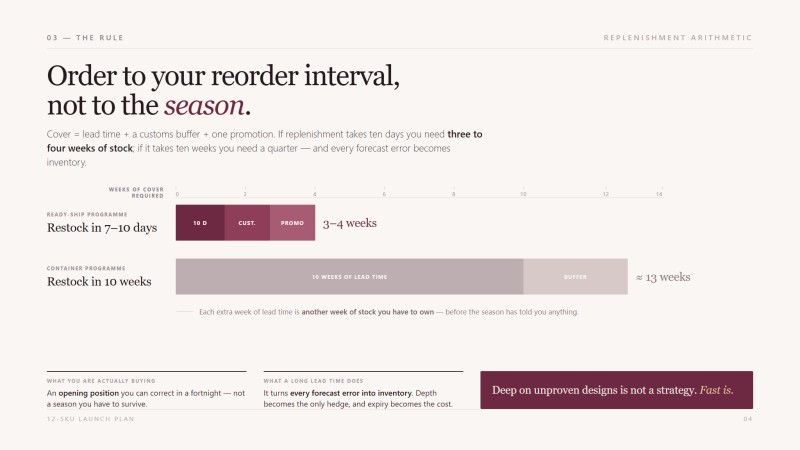
Order to your reorder interval, not to the season.
If replenishment takes ten days, you need roughly three to four weeks of cover — a buffer for customs and a buffer for a promotion. If replenishment takes ten weeks, you need a quarter of stock, and every forecast error becomes inventory.
This is the practical advantage of a ready-ship programme: 1,500+ designs held in stock and despatched in 7–10 days change the arithmetic of a first order. You are no longer buying a season; you are buying an opening position that you can correct in a fortnight.
What that looks like in practice:
- Buy shallow on everything in the test role — enough to fill the shelf and to sample, nothing more.
- Buy medium on natural everyday, because that is where you expect repeats.
- Buy deeper only on the two or three designs you can already justify — an existing customer request, a shelf you have observed, a competitor's bestseller you are answering.
- Never buy a design you cannot describe to a shop assistant in one sentence. If you cannot brief it, it will not sell.
A worked example
Illustrative numbers only — substitute your own prices and volumes.
Say your opening buy is 720 pairs across 12 SKUs, 60 pairs per SKU. In week five, eight of the twelve read like this (cover left = units remaining ÷ weekly rate):
| SKU role | Pairs sold in 5 weeks | Units left | Cover left | Decision |
|---|---|---|---|---|
| Hero A | 38 | 22 | ~3 weeks | Reorder now, double depth |
| Hero B | 30 | 30 | ~5 weeks | Hold; reorder at week 8 if it holds |
| Hero C | 11 | 49 | ~22 weeks | Move to the "try me" slot; do not reorder |
| Natural A | 44 | 16 | ~2 weeks | Reorder immediately, deepest line |
| Natural B | 33 | 27 | ~4 weeks | Reorder standard depth |
| Natural C | 14 | 46 | ~16 weeks | Hold |
| Prescription A | 26 | 34 | ~6 weeks | Reorder at half depth; check power range |
| Test A | 9 | 51 | ~28 weeks | Keep as sample only |
Two lessons fall out of a table like this, and neither is visible from a headline sales figure.
First, the reorder list is shorter than the original order list. That is the system working. A first order that produces more holds than reorders is a success; a first order that produces twelve equal reorders usually means nobody is reading the data.
Second, the constraint is often not the design. Prescription SKUs that sell steadily but slowly are frequently limited by power availability at the shelf, not by demand. Check the range you actually stock before you conclude the design is weak.
What to measure in the first six weeks
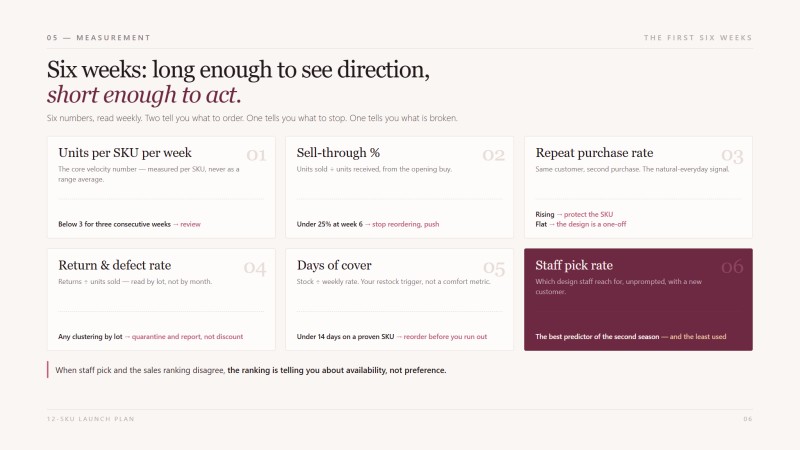
Six weeks is long enough to see direction and short enough to act before the season ends.
| Metric | How to read it | Action threshold (heuristic) |
|---|---|---|
| Units per SKU per week | The core velocity number | Below 3 for three consecutive weeks → review |
| Sell-through % | Units sold ÷ units received | Under 25% at week 6 → stop reordering, push |
| Repeat purchase rate | Same customer, second purchase | Rising → protect the SKU; flat → the design is a one-off |
| Return and defect rate | Returns ÷ units sold | Any clustering by lot → quarantine and report, not discount |
| Days of cover | Stock ÷ weekly rate | Under 14 days on a proven SKU → reorder before you run out |
| Staff pick rate | Which design staff recommend unprompted | The best predictor of the second season |
The last one is the most under-used. Ask three counter staff which design they reach for with a new customer, and compare their answer with your sales ranking. When the two disagree, the sales ranking is telling you about availability, not preference.
Graduating from 12 to 24 to 40
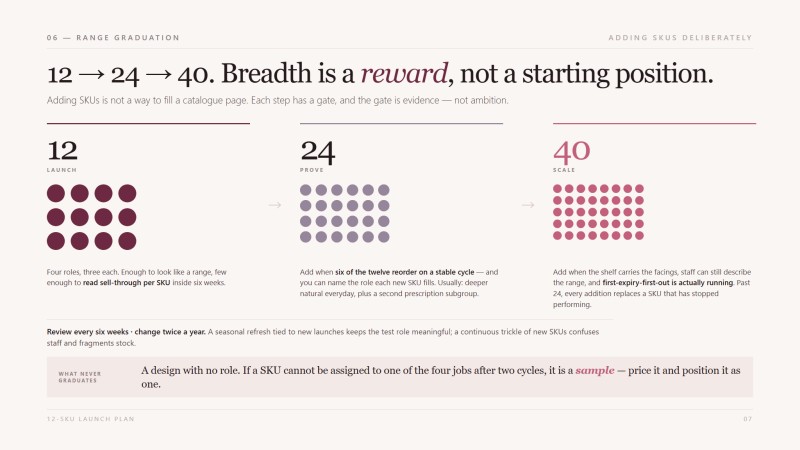
Adding SKUs is a reward for proven performance, not a way to fill a catalogue page.
12 → 24: add when at least six of the original twelve are reordering on a stable cycle, and when you can name the role the new SKUs fill. Typically this means deepening natural everyday and adding a second prescription subgroup rather than adding more fashion.
24 → 40: add when the shelf can carry the facings, staff can still describe the range, and your stock room has a working first-expiry-first-out process. If rotation is already weak at 24, adding SKUs makes the write-off problem worse, not better — the discipline has to exist before the breadth.
What never graduates: a design with no role. If a SKU cannot be assigned to one of the four jobs after two cycles, it is a sample, and it should be priced and positioned as one.
Colour vocabulary that prevents bad briefs
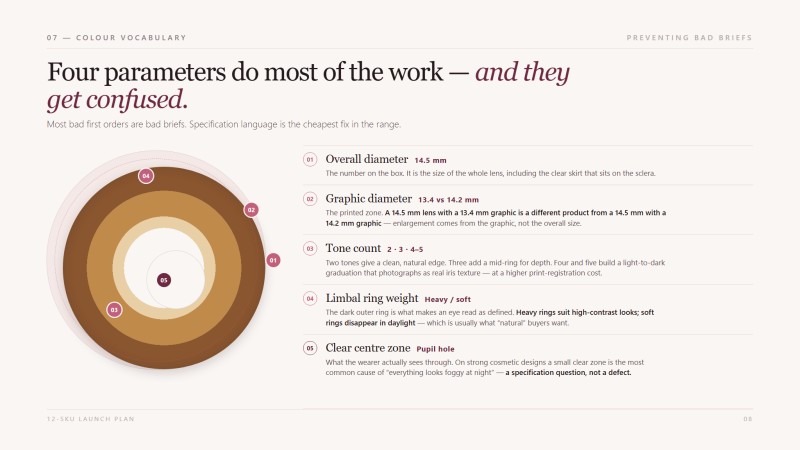
Most bad first orders are bad briefs. Four parameters do most of the work, and they are routinely confused.
Overall diameter vs graphic diameter. A 14.5 mm lens with a 13.4 mm graphic is a different product from a 14.5 mm lens with a 14.2 mm graphic, even though both are sold as "14.5". Enlargement comes from the graphic, not the overall size.
Tone count. Two tones give a clean, natural edge. Three tones add a mid-ring for depth. Four and five tones let a designer build a light-to-dark graduation that photographs well and reads as real iris texture up close. More tones is not automatically better — it is a different look, with a higher print registration requirement.
Limbal ring weight. The darker outer ring is what makes an eye read as defined. Heavy rings suit high-contrast makeup looks; soft rings disappear in daylight, which is usually what "natural" buyers want.
Pupil hole and centre clear zone. The clear centre is what the wearer actually sees through. On strong cosmetic designs, a small clear zone is the most common cause of the "everything looks foggy at night" complaint, and it is a specification question, not a defect.
Market differences: audit, do not assume
Taste varies by market, and it varies faster than any generalisation about regions can track. Rather than ordering to a stereotype, run a two-hour local audit:
- Visit three stores that already sell colored lenses — a chain optical, a beauty retailer, a pharmacy counter. Photograph the shelf and count facings per tone family.
- Note what is sold out, not what is displayed. Empty slots are the only honest demand signal on a shelf.
- Ask one question at the counter: "Which of these do customers ask for by name?" The answer is your hero shortlist.
- Check the price ladder — the number of tiers tells you whether the market buys on design or on price.
- Compare with your own data after six weeks. If your sell-through contradicts the shelf audit, trust your sell-through; the shelf may simply be under-stocked.
Do this before every season, not once. In markets where online beauty content drives demand, trends now arrive from social video rather than from the optical trade, and the shelf lags by a quarter.
Operations that protect the margin
An assortment plan is only as good as the stock discipline behind it.
- Rotate by expiry, not by arrival. Bin by expiry quarter and run a monthly expiry report; the detail is in our guide to contact lens storage for distributors.
- Keep a physical sample kit per salesperson, refreshed each season, with the twelve live SKUs and nothing else. A kit that contains everything communicates nothing.
- Train on the four roles, not on the full catalogue. Staff who can say "this one for a natural look in daylight, this one if you want it visible in photos" sell more than staff who list specifications.
- Plan markdowns at 120 days to expiry, not at 30. Discounting early protects the margin; discounting late protects nothing and looks like a clearance signal to the trade.
- Keep the documentation pack current. Distributors in regulated markets are increasingly asked for CE and ISO 13485 evidence, shelf-life statements and lot traceability at onboarding. Our why-us page summarises what we provide, including FDA-registered facility details (FEI 3015587162) for the US market and EUDAMED guidance for the EU.
Working with a 1,500-design catalogue
A large catalogue is an asset only if you use it as a reservoir rather than a menu.
- Shortlist 30, launch 12. Keep the shortlist documented with the reason each design was considered, so next season's review has a baseline.
- Use new launches as test slots. We release 100+ designs a year with Pantone-validated colours; the test role in your assortment is where those launches earn their place, one or two at a time.
- Replenish, do not re-forecast. With 7–10 day despatch, the correct response to a fast-moving design is an order, not a projection.
- Retire deliberately. Every SKU you add should replace one that has stopped performing, once you are past 24. A range that only grows becomes unmanageable at the shelf.
If you want to build the first twelve against your own market, send us your channel mix, your price band and the designs you are considering — we will come back with an opening allocation and a restock plan. Start from the product catalogue or the latest news for what is shipping this season.
Frequently asked questions
How many colored contact lens SKUs should a new distributor start with? Twelve is a workable opening position: three hero fashion, three natural everyday, three prescription-ready, three test or seasonal. It is enough to look like a range, few enough for staff to learn and for you to read sell-through per SKU within six weeks.
Is it better to stock many designs shallowly or few designs deeply? Few designs deeply, if your replenishment is fast. Depth on proven designs protects sales; depth on unproven ones becomes expiry risk. With a 7–10 day restock window, shallow-plus-fast beats deep-plus-static in almost every case.
What sell-through should I expect in the first six weeks? Treat 25% as the review line rather than a target. Below that at week six, stop reordering and push the stock you hold. Well above it, you have an availability problem, not a demand problem — reorder before you run out.
How do I choose between 14.2 mm and 14.5 mm lenses? Choose by graphic diameter and by the look you are selling. 14.2 mm suits natural and everyday positioning; 14.5 mm with a wide graphic reads as visibly enlarging and photographs strongly. Stocking both in the same tone family lets staff offer a choice instead of a compromise.
Do prescription-ready designs need separate staff training? They need a different conversation. The customer already wears lenses, so the discussion is about design and comfort rather than about conversion. Keep the power range visible on the shelf and let staff compare the same pattern in plano and powered versions.
How often should I refresh the assortment? Review every six weeks, change twice a year. A seasonal refresh tied to new launches keeps the test role meaningful; a continuous trickle of new SKUs confuses staff and fragments stock.
What is the biggest cause of write-offs for a new distributor? Buying the test role at natural-everyday depth. Test SKUs should be bought to sample and to fill a shelf, never to cover a season — the whole point of the role is that you do not yet know the answer.
Can I mix replacement cycles in one range? Yes, and most distributors should. Daily lenses serve trial and hygiene-first buyers, monthly serves repeat purchase, yearly serves the cosmetic buyer who wears occasionally. The mix matters more than any single cycle, because each one brings a different purchase rhythm into your account.
