Contact Lens Storage for Distributors: Rotation and Climate
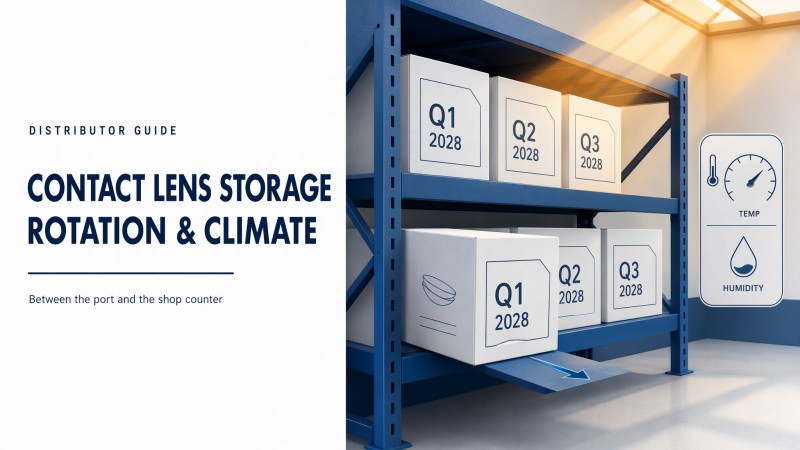
Quick answer: Treat incoming contact lenses as temperature-sensitive medical devices, not fast-moving cosmetics. Contact lens storage for distributors is a rotation and climate problem before it is a shelving problem. Inspect every carton at receiving, store stock in first-expiry-first-out order with a visible expiry report, keep the store room stable and dry rather than cold, and never let a steel container, a skylight or a rainy season decide your shelf life for you. A distributor who controls rotation and climate loses far less stock to write-offs — and avoids the one cost that no margin covers: a customer with an eye infection and a photograph of your label.
This is written for the people holding the inventory: importers, regional distributors, optical chain buyers and the warehouse supervisor who actually moves the pallets. The lens chemistry is the manufacturer's job. What happens between the port and the shop counter is yours, and it is where most avoidable losses occur.
Why contact lens storage is a commercial issue
Three cost lines move when storage discipline is weak, and only one of them appears on the P&L immediately:
- Write-offs. Near-expiry stock that was never rotated becomes unsellable. In a category with 1,500+ designs in circulation, slow movers are inevitable — unmanaged slow movers are not.
- Returns and complaints. A lens that was heat-cycled in a container may look perfect and feel wrong. That becomes a return, a credit note and a damaged relationship.
- Safety exposure. A lens stored in non-sterile conditions, or sold past expiry, is a patient-safety event. In most markets contact lenses are regulated medical devices, and the distributor's storage conditions are part of the traceable chain.
There is also a fourth, quieter cost: a market you cannot enter. Buyers in regulated markets increasingly ask for storage conditions and remaining shelf life as part of supplier qualification. Having the answers ready shortens onboarding.
Receiving: the six-point inspection
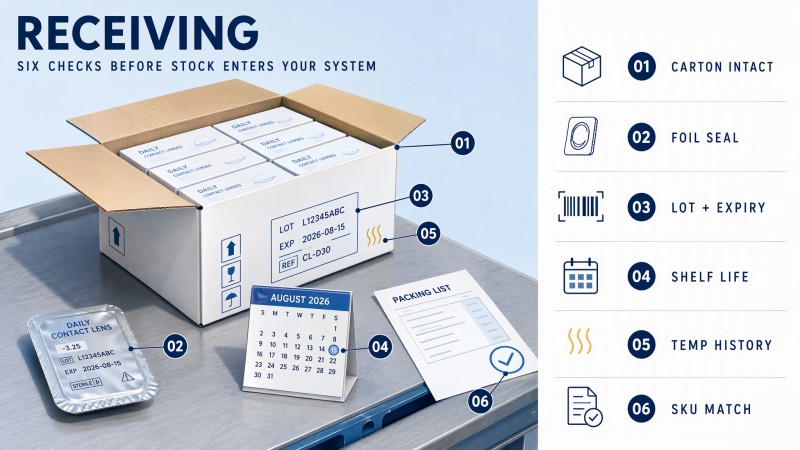
Do this before stock enters your system, not after.
| Check | Pass criteria | Action if it fails |
|---|---|---|
| Outer carton integrity | Dry, undented, no crush marks | Quarantine the affected cartons; do not blend with good stock |
| Foil seal | Intact, flat, not lifted or delaminated | Reject the unit — sterility cannot be restored |
| Lot and expiry legibility | Printed and readable on foil and carton | Reject or return; unreadable expiry is unsellable |
| Remaining shelf life | Meets the minimum you contracted for | Escalate to supplier before acceptance |
| Temperature history | No sign of heat exposure (warped cartons, softened adhesive, condensation marks) | Photograph, notify supplier, quarantine |
| Quantity and SKU match | Matches the packing list by design code | Reconcile before shelving |
Photograph exceptions at the dock. A timestamped photo is the difference between a supplier credit and an argument.
First-expiry-first-out in practice
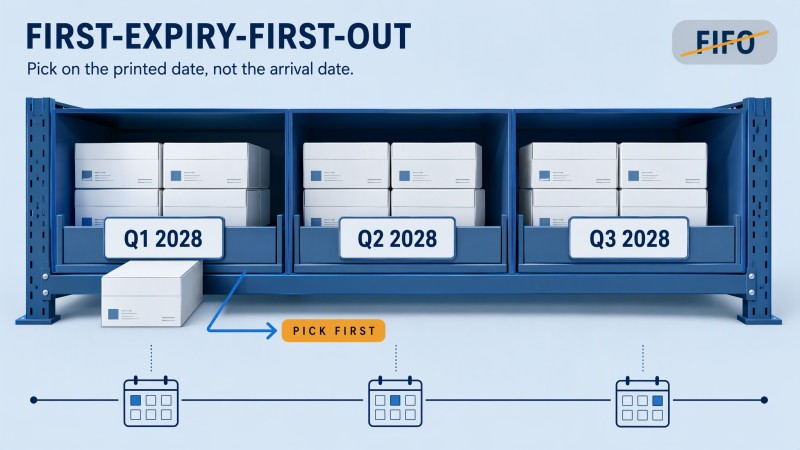
FIFO — first in, first out — is the wrong rule for this category. A shipment that arrived last week may expire before one that arrived last month. Pick on the printed date.
How to make FEFO real rather than aspirational:
- Bin by expiry quarter, not by arrival date. Labels reading
Q1-2028,Q2-2028make rotation visible at a glance. - Run a monthly expiry report. Any SKU inside 90 days of expiry goes on a push list; inside 30 days it is pulled from saleable stock.
- Keep the carton with the unit. Decanting lenses into open trays destroys the lot and expiry link.
- Do not re-pack across batches. If you must split a carton, keep the original label with the split units.
- Rotate retail shelves front-to-back weekly, and check expiry at the point of sale — it is the last checkpoint.
Climate: the variable most distributors underestimate
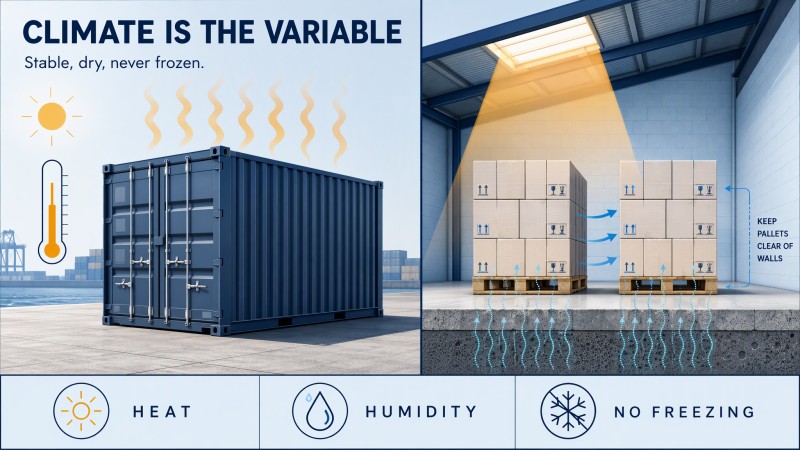
This is the part of contact lens storage for distributors that receives the least attention and causes the most write-offs. Contact lenses do not need a cold chain. They need stability. The two enemies are heat and moisture, and both are endemic to the markets many distributors serve — the Gulf, West Africa, South and Southeast Asia, and Latin America.
Heat. A steel shipping container sitting on a quay in direct sun can get substantially hotter than the ambient air around it, and a warehouse roof zone runs several degrees above floor level. Practical controls:
- Site pallets away from skylights, roof metal, external walls with sun exposure and dock doors.
- Never store stock in a vehicle cab, a glass-fronted shop window or an unventilated mezzanine.
- Allow air to move: do not push pallets flush to walls or block ventilation gaps.
- Treat heat-exposed cartons as suspect even if the contents look normal.
Humidity. High humidity softens cartons, lifts labels and drives mould on outer packaging. Moisture also tracks toward the foil seal. Keep the store dry, fix roof and pipe leaks before the rainy season rather than during it, and never store cartons directly on a floor slab that sweats.
Never freeze. Lenses should not be exposed to freezing temperatures either. If you handle cold-chain goods in the same facility, keep lenses out of those zones and off the shared loading dock.
Sea freight and air freight: what to specify
- Ask your supplier to ship lenses away from heat-generating cargo and out of the container's top layer against the roof.
- Confirm the container is not being used for goods that outgas — foil resists microbes, not vapour.
- For air freight, note that holds can be very cold; lenses should travel in the belly-hold cargo compartment, not exposed to freezing conditions on a cold-climate tarmac for extended periods.
- Specify a minimum remaining shelf life at shipment. A clear number in the purchase order prevents accepting stock that arrives with most of its life already spent.
Read more about how we handle shipment lead times in our latest news and updates, including market expansion notes for distributors entering new territories.
Slow movers and near-expiry stock
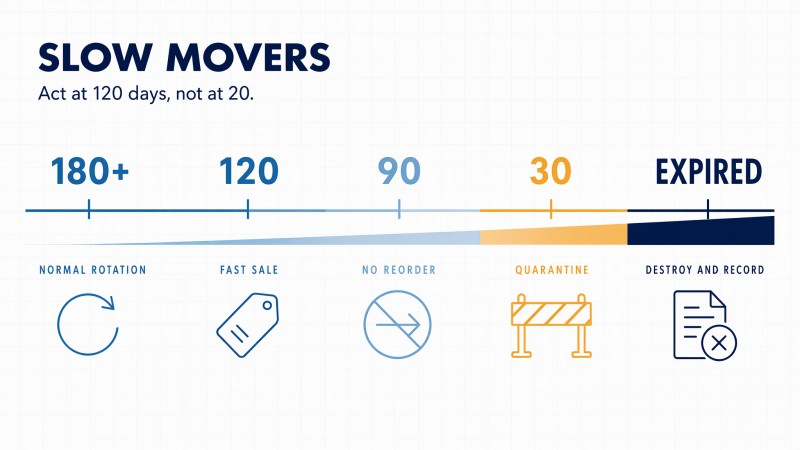
Every catalogue with a large design count has slow movers. The question is what you do at 120 days out, not at 20.
| Time to expiry | Action |
|---|---|
| 180+ days | Normal rotation; monitor sell-through |
| 120 days | Move to a "fast sale" slot; bundle with popular SKUs |
| 90 days | Stop reordering; push to high-traffic accounts |
| 30 days | Pull from saleable stock; quarantine |
| Expired | Destroy per local medical-device waste rules; record it |
Two rules are non-negotiable: never sell an expired lens, and never extend a shelf life by re-labelling. Both are regulated violations in most markets and indefensible in a customer conversation.
Temperature and your own team
Storage discipline fails at handover, so make it a written routine:
- Training covers receiving checks, FEFO picking and what "quarantine" means physically — a marked area, not a note.
- One named person owns the monthly expiry report.
- Damaged or suspect stock has a single, obvious destination.
- Delivery drivers know that cartons do not ride in the cab or on an open bed in sun.
Emergency scenarios
- Power cut in a climate-controlled room: lenses do not require refrigeration, so a short outage is not a crisis — but keep the room closed, avoid opening the dock, and check humidity afterwards.
- Flood or leak: cartons that got wet are quarantine stock, not discount stock. Water wicks along paper and reaches the seal.
- Fire or smoke exposure: outgassing and heat make the whole batch suspect; do not sell it on.
- Refrigerated truck used by mistake: find out the temperature reached and whether it froze. Freezing is a reject condition.
What good looks like
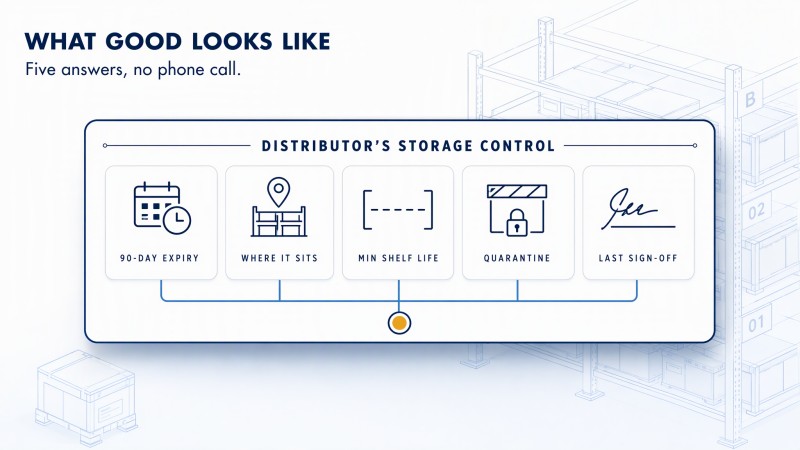
A distributor with strong storage control can answer five questions instantly: how much stock expires in the next 90 days, where it is physically located, what the contracted minimum remaining shelf life is, which units are quarantined and why, and who signed off the last expiry destruction. If any of those takes a phone call, the process is not yet a process.
Our product catalogue is organised so that high-rotation designs — such as the Macabaka Purple four-tone 14.2 mm and the Ashy Bubble Grey five-tone — ship alongside slower fashion shades. That mix is exactly why rotation discipline, not reordering discipline, decides your write-off rate.
Frequently asked questions
Do contact lenses need to be refrigerated in a warehouse? No. Contact lenses are not a cold-chain product. They need stable ambient temperature, protection from direct sunlight and heat sources, low humidity and no freezing. Refrigeration adds condensation risk without benefit.
What is the shelf life of contact lenses? Shelf life is set by the manufacturer's stability validation and printed on the foil and carton. It varies by product and is not extended by storage conditions, so always plan against the printed date rather than an assumed period.
How should stock be rotated? First-expiry-first-out. Bin stock by expiry quarter, run a monthly expiry report and rotate retail shelves front-to-back weekly.
What should I do with cartons damaged in transit? Quarantine them. A crushed or punctured carton may have compromised the foil seal, and sterility cannot be restored. Photograph the damage, notify the supplier and do not mix the units with saleable stock.
Can I sell contact lenses that are close to expiry? You can sell stock while it is within its printed shelf life, provided it has been stored correctly. Once expired, it must be destroyed under local medical-device waste rules. Never re-label or extend a date.
What is minimum remaining shelf life and why ask for it? It is the shortest remaining shelf life you are willing to accept at shipment, written into the purchase order. Specifying it prevents receiving stock that arrives with most of its usable life already consumed.
How hot is too hot for contact lens stock? There is no single number that applies to all products — the validated storage conditions on the label define the envelope. Practically, avoid direct sun, roof zones, unventilated vehicles and containers in quayside sun, and treat visibly heat-affected cartons as suspect.
Should distributors remove secondary cartons to save space? No. The carton carries the lot number, expiry and storage statement. Removing it breaks traceability and exposes the foil to handling damage.
- FDA,《Contact Lens Risks》— https://www.fda.gov/medical-devices/contact-lenses/contact-lens-risks
- CDC,《Preventing Eye Infections When Wearing Contacts》— https://www.cdc.gov/contact-lenses/prevention/index.html
